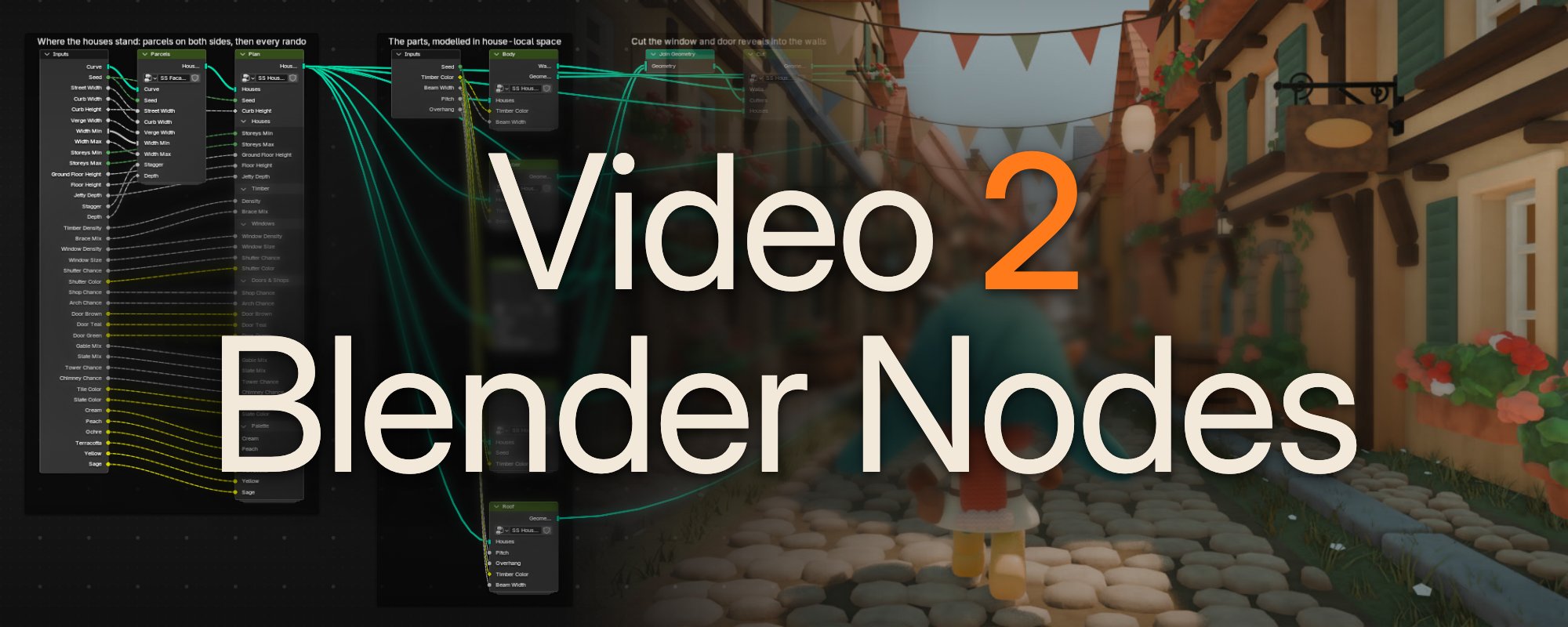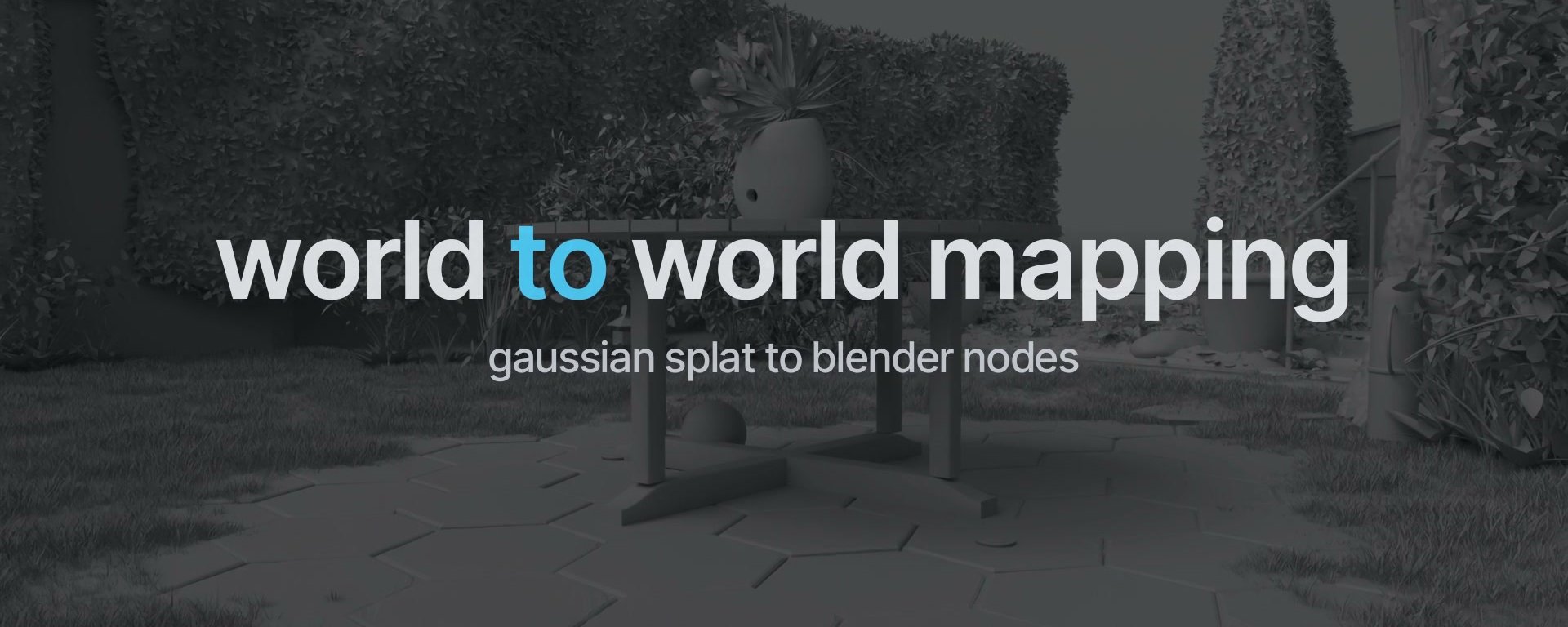
Video 2 GLSL started with a reference clip and rebuilt it as executable mathematics. Video 2 Blender Nodes took the next step: a scene made of native node graphs that an artist could open and change.
World to World Mapping starts with a captured 3D scene. I used Claude Code to study a Gaussian splat of a garden, reconstruct its objects with Blender Geometry Nodes and Shader Nodes, then map captured appearance onto selected surfaces. The result has two useful layers: a procedural description of the scene and a textured hybrid that brings some of the capture's surface detail back.
The question behind it is simple: can a captured place become a construction system you can keep working with?
Two pieces that work together
gaussian-splat-to-blender-nodes gives coding agents a skill, reusable prompts and tools for measured reconstruction. The agent studies the reference, identifies objects and construction patterns, writes native node graphs, renders them and corrects the differences.
An optional appearance-mapping stage projects calibrated captures onto selected reconstructed surfaces. Geometry provides the structure; captured images supply details such as stains, wear and uneven colour. Procedural materials cover surfaces where the captures do not provide a usable sample.
The Garden study brings these stages together. It uses the Mip-NeRF 360 Garden scene displayed through GaussianSplats3D as its reference. The workflow begins with an existing splat; it does not train a new one.
Start by establishing a shared world
A splat gives the agent something it can inspect from several directions. That makes matching cameras, coordinates and scale the first useful job.
The workflow records the source asset, establishes a scan-to-Blender transform, and captures repeatable hero, side, opposite, overview and detail views. Reference and reconstruction use the same camera definitions. Otherwise a focal-length or framing error can look like a modelling error, and a texture can land on the wrong surface even when it looks plausible from one angle.
Garden's scale uses an assumed table height as an anchor. Its dimensions are a reconstruction estimate, not a survey. The reference views constrain the visible scene; hidden surfaces still need interpretation.
Build objects with meaningful controls
The procedural Garden is divided into seven parts: ground, table, vase and arrangement, tree, shrubs, boundary and structures. Each part has its own Geometry Nodes construction and Shader Node materials.
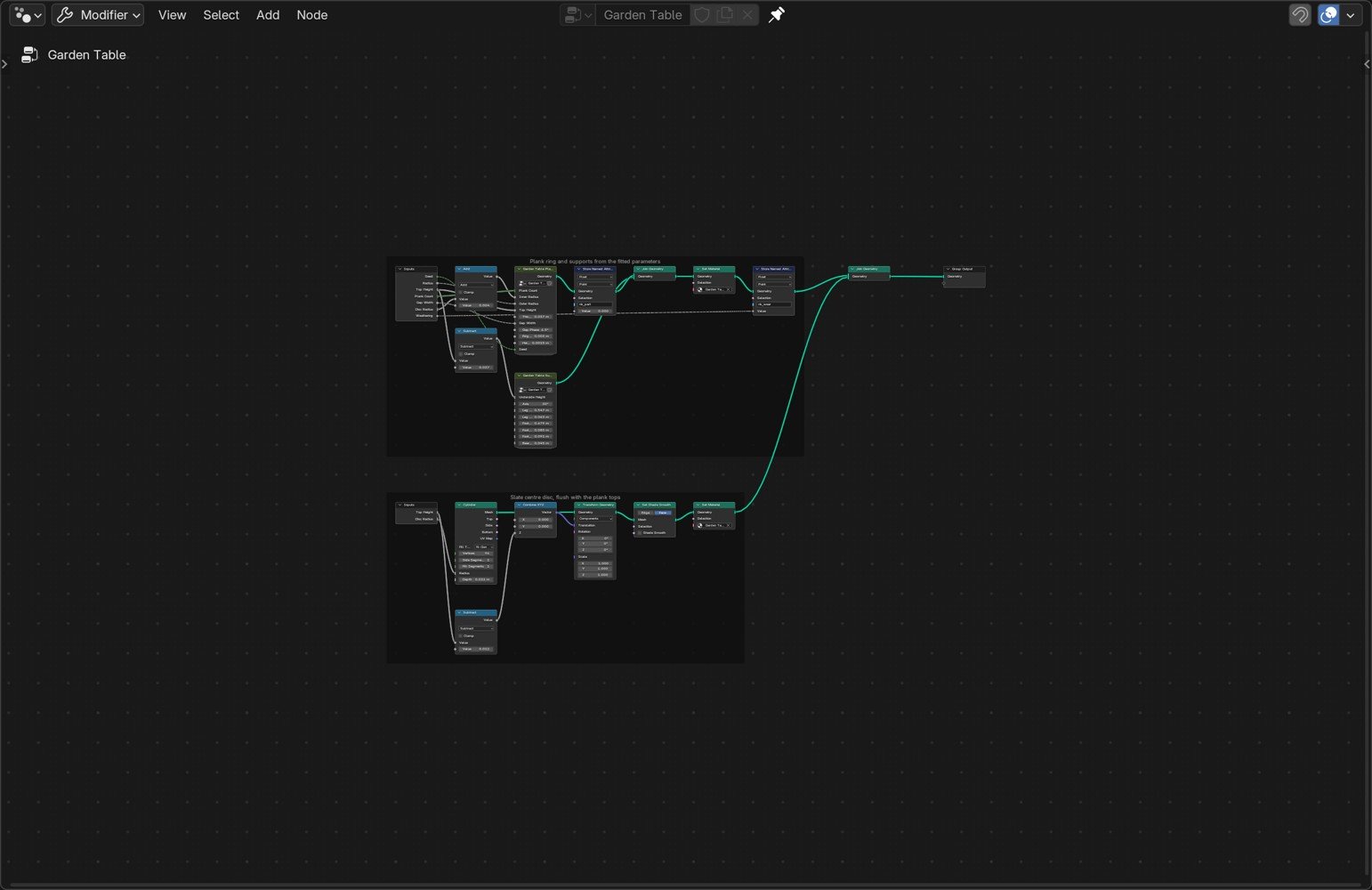
The table is a useful example. Its top is a ring of radial wooden planks around a slate centre, with modelled gaps, bevels and supports underneath. The source graph exposes controls such as Radius, Top Height, Plank Count, Gap Width, Disc Radius and Weathering. The paving has joint width, bevel and settling controls. The vegetation has density, size and variation controls.
Those names express decisions an artist can understand. A reconstruction can leave behind a table-building system or a paving system that is useful beyond the original view. The controls still need testing: exposing two dimensions does not automatically establish the correct relationship between them.
Python builds the native graphs using node-building helpers carried over from video-to-blender. Frames, subgroups, named inputs and descriptions make the construction readable in Blender.
Judge the assembled scene from several views
The build progressed through a complete blockout, individual part work and repeated visual review. Claude Code built the scene while Codex supplied critiques from the comparison renders. Separate part builders shared coordinates, measurements and interfaces, but the assembled garden remained the thing being judged.
A clean script or a detailed object is only one checkpoint. The table, paving and plants have to agree in the same image. Review starts with large differences in silhouette, placement and proportions, then moves to surface detail and lighting.
The native-scene audit checks whether the generated geometry remains after removing the reference collection in memory. That establishes independence from the splat for the procedural construction. Visual resemblance needs its own evidence from matched renders.
Map the captured appearance back onto the geometry
Procedural materials made the garden editable, but they did not reproduce every stain, worn patch or irregular paving mark in the capture. The hybrid stage adds that appearance after the geometry has been established.
The reusable pipeline has three stages:
- Prepare. Evaluate selected mesh objects, prepare UVs, and record surface positions, normals, material identities and visibility from the shared cameras.
- Project. Sample the calibrated captures, reject unsuitable views and contaminated samples, blend usable observations, and record where coverage is missing.
- Assemble. Put the resulting textures and mix masks onto mesh copies, retain the original material as fallback, and pack the new images into a separate Blender file.
For the accepted Garden hybrid, direct capture coverage is about 84% of valid paving UV texels and 48% of valid table UV texels. These numbers measure texture coverage, not reconstruction accuracy. Unseen or rejected regions use procedural fallback, with a transition band between the two.
The difficult part is choosing the right evidence
Projection can transfer the wrong object just as easily as the right one. In Garden, a scanned teal ball left a duplicate colour mark on the reconstructed table support and paving. Rejecting those contaminated samples substantially removed the ghost; places without a clean replacement returned to the procedural material.
Reconstructed depth alone cannot identify every occluder present in the original capture. The portable workflow therefore accepts source-validity masks and project-specific rejection rules. It also respects actual material slots so a stone region does not accidentally receive a wood treatment.
Another lesson was to judge changes across views. A material adjustment that improved the hero image made the opposite view worse and was rejected. Small residuals at rough splat boundaries were accepted once the larger projection errors were addressed.
Show the geometry and appearance separately
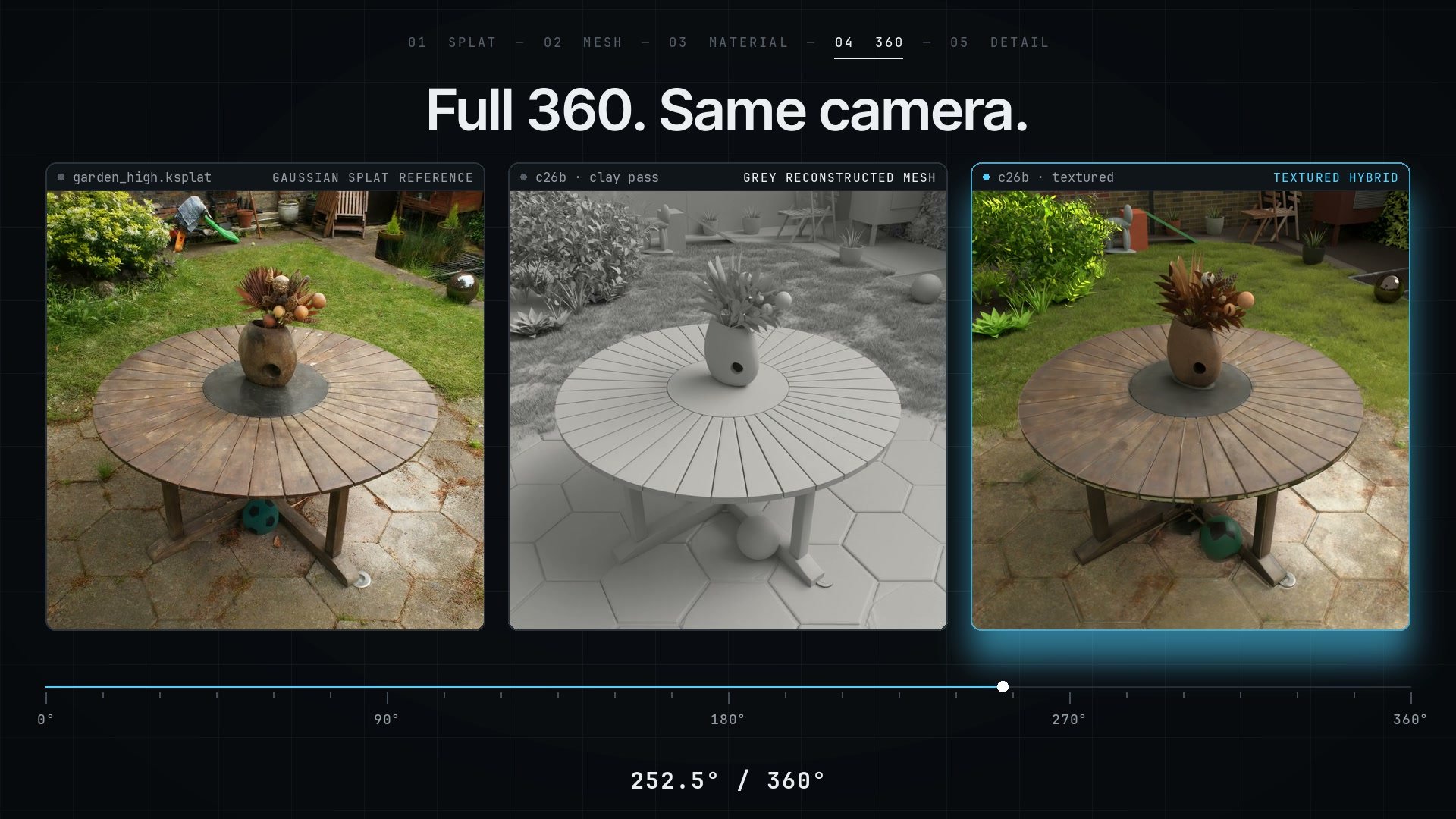
The release video compares the Gaussian-splat reference, a neutral grey reconstruction and the textured hybrid through a full turn. The orbit uses 288 shared camera poses, advancing 1.25 degrees per frame.
The grey and textured versions use the same reconstructed geometry, cameras and lighting; the grey pass replaces the materials. Held comparisons and moving reveals make it easier to see which details are modelled and which come from appearance. Table, support and paving close-ups show the surfaces at a more useful scale.
A complete orbit makes differences visible on the other side of the scene. It is useful comparison evidence, though it does not make the reconstruction exact.
What stays editable
The procedural source retains its Geometry Nodes controls and Shader Node materials. In the accepted hybrid, the mapped table and paving are baked evaluated meshes with packed textures. Other reconstructed parts retain their live node-based construction.
Changing the source table's dimensions does not automatically update its mapped copy. Geometry or UV edits require preparing and projecting those surfaces again. Keeping the procedural source separate preserves the construction recipe while making that rebaking requirement explicit.
Captured appearance also includes illumination and view-dependent effects. The tools offer unlit captured radiance or an approximate lit treatment, but neither recovers clean physical albedo. This hybrid is not evidence of faithful relighting under arbitrary new lights.
What carries over to another scene
The repository separates the reusable workflow from Garden's fitted example. Objects, material slots, cameras, source masks and projection settings are supplied per project. The prompts cover scene capture, part contracts, detail passes, critique and delivery.
The agent still has to decide how the scene is constructed. The toolkit does not include automatic semantic segmentation or a universal splat renderer. Garden is one worked study, with visible differences in foliage, construction and material response; broader reliability remains something to test.
The useful output is both the scene and the process that produced it: source code, parameters, cameras, comparison evidence and a record of the remaining differences.
Try it with your own reference
Install the skill with:
npx skills add gokayfem/gaussian-splat-to-blender-nodes
Use Python 3.10+ and Blender 5.0+; the local integration was checked on Blender 5.0.1. The prompt pack includes a project brief and the capture, build and review stages. The hybrid mapping guide covers the optional texture pass.
A small synthetic starter lets you test the pipeline without a scan. The full repository includes the procedural Garden example; the original scan and fitted hybrid textures are separate from the code distribution.
Video 2 GLSL turned a visual reference into a shader. Video 2 Blender Nodes turned it into a procedural tool. World to World Mapping explores the same idea with captured places: build an editable scene from the observations, then carry useful captured appearance into that new representation.
Repository: github.com/gokayfem/gaussian-splat-to-blender-nodes