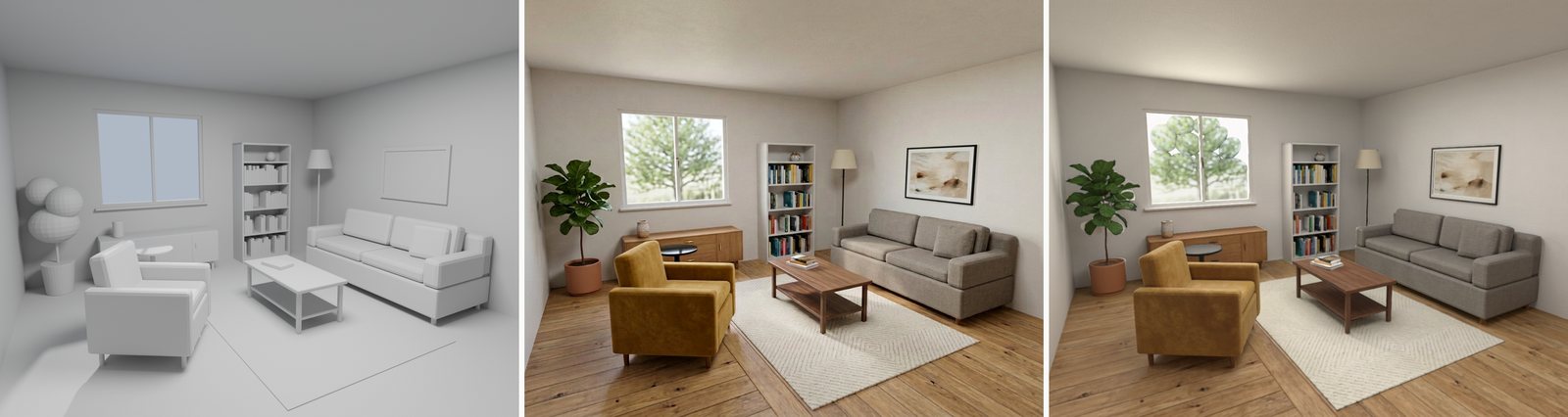
Blockout 2 Real gave a grey scene materials and light from one fixed camera. Move that camera and the surfaces it never constrained show their fills.
Several cameras should fix that. They also bring a harder problem: an image model can paint six convincing photographs of one room, and no two of them agree on the grain of the floor.
Multiview Blockout 2 Real is an open-source skill and toolkit for that problem. It renders a grey scene from several calibrated cameras, asks an image model for every view in one sheet, projects the views into each object's own UV textures, and ends in two Blender files: a baked diagnostic and a relightable scene. It uses no Gaussian splats and no image-to-3D model, so the geometry stays the one you blocked out.
Ask for every view in one picture
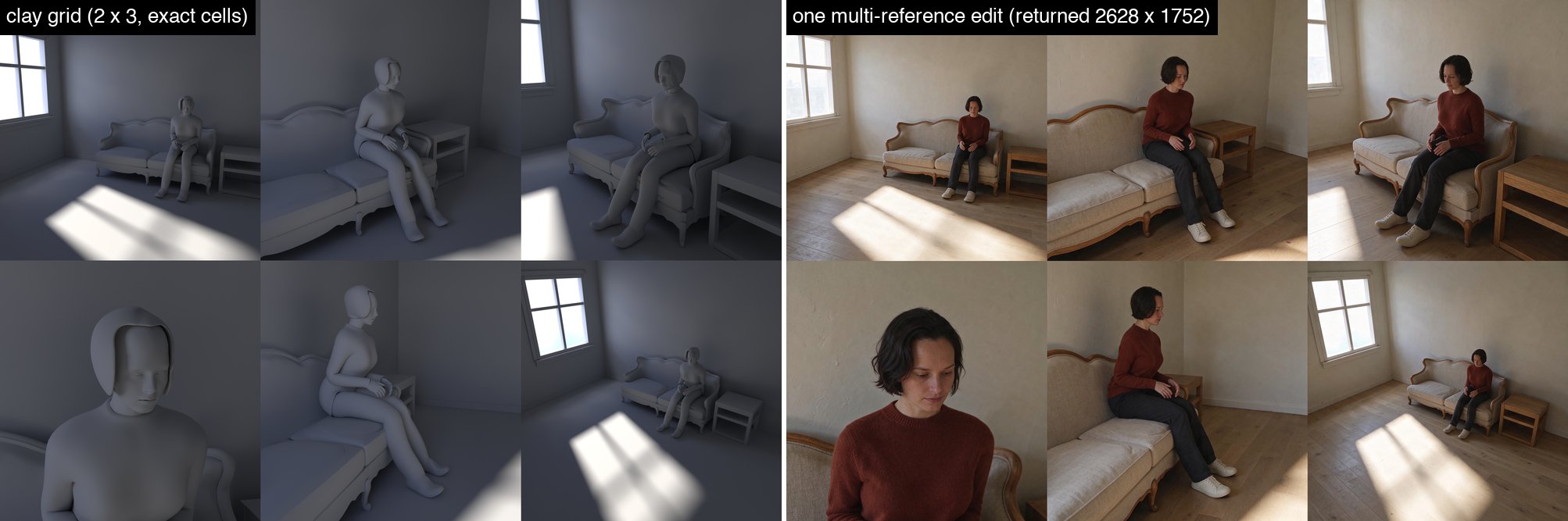
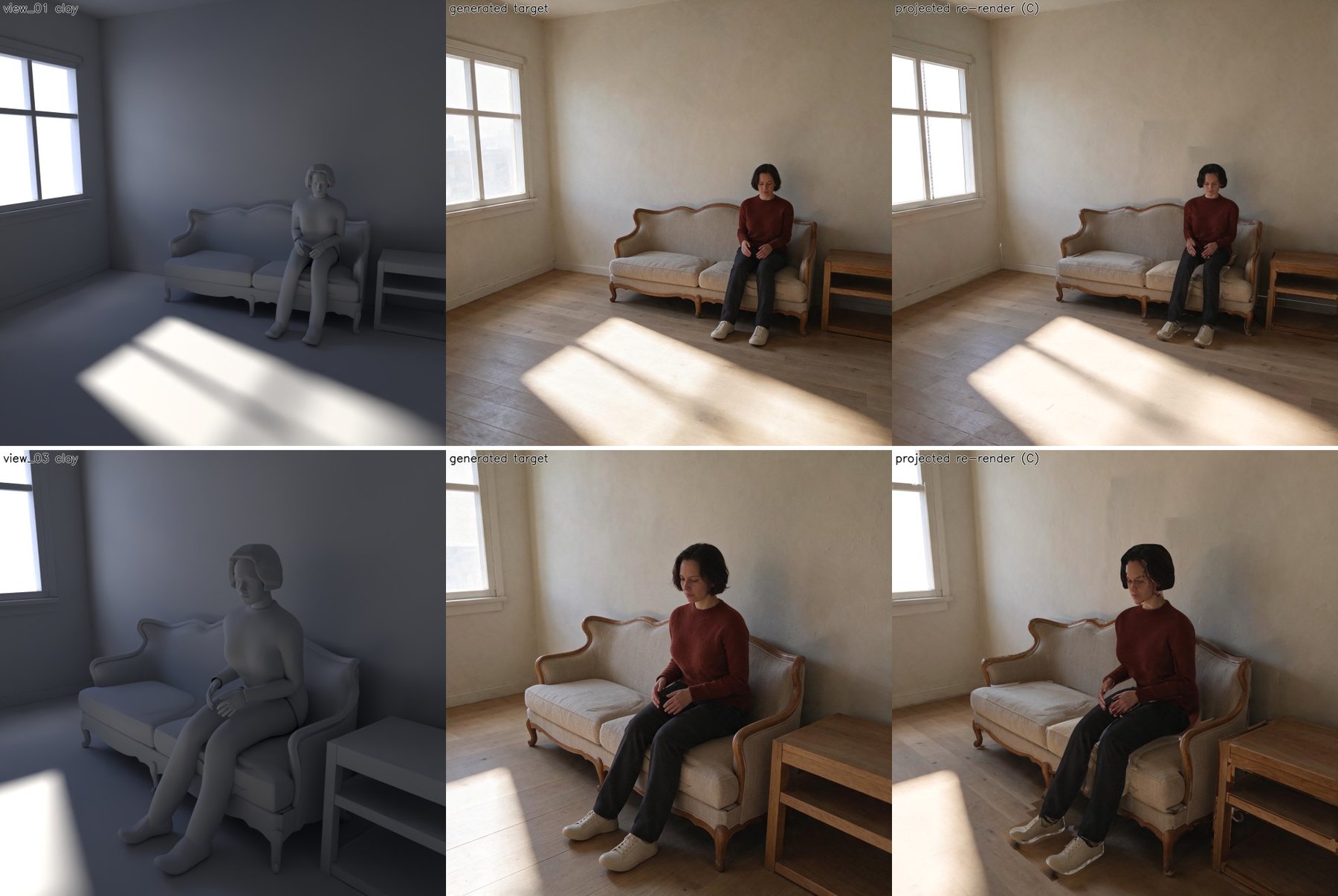
The first run is one room, 4.5 by 4 by 2.7 metres, with a sofa, a side table, a window and one seated mannequin. Six cameras look at it at 1664 x 1664: a frontal wide, two three-quarter views, a face close-up, a side view and an elevated wide. Each renders a clay image and exact passes for depth, normals and object ids.
The six clay views are laid out as one 2 x 3 sheet, and Seedream 5.5 on fal edits that sheet in a single multi-reference call. One call means one lighting decision and one person across all six panels.
Each panel is then refined on its own and held to the geometry under a fixed acceptance rule. One refinement was rejected because the head sat 11.5 px too low; its retry passed.
Measure how far the views agree
Six generated photographs agree on the layout and disagree on the detail. Reprojected through the known geometry, the refined views agreed on colour and light to 5.19 ΔE. On fine detail their correlation was 0.161, where a re-render of one shared texture scores 0.947 on the same measure.
A render-then-refine round brought colour and light to 3.38 ΔE, 35% better, and fine detail to 0.244. Floor boards improved from 0.207 to 0.489. Linen weave, knit and hair stayed specific to each view.
That decides the fusion. Colour and light can be blended across views. Fine detail cannot be averaged without ghosting, so each texel takes its detail from one view, chosen with seam-aware labels.
A view can also be wrong as a whole. On a second input the model returned one panel as a near-copy of its neighbour, and projecting it smeared a second ball across the floor. A per-view gate now rejects a view whose image matches another camera's clay better than its own.
Projection is the hard part
Each texel of each object looks back through every camera, with a visibility test against that camera's depth. A boundary a few pixels off is enough to paint trouser colour on a fingertip. On the first gate, 4.3% of the observed skin texels had taken another object's pixels.
The strict gate shrinks each object's own region and its generated mask, rejects every other object's mask and keeps a margin around nearer silhouettes. Run on the same room at full resolution, the leak count went to 0 of 13.2 million texels.
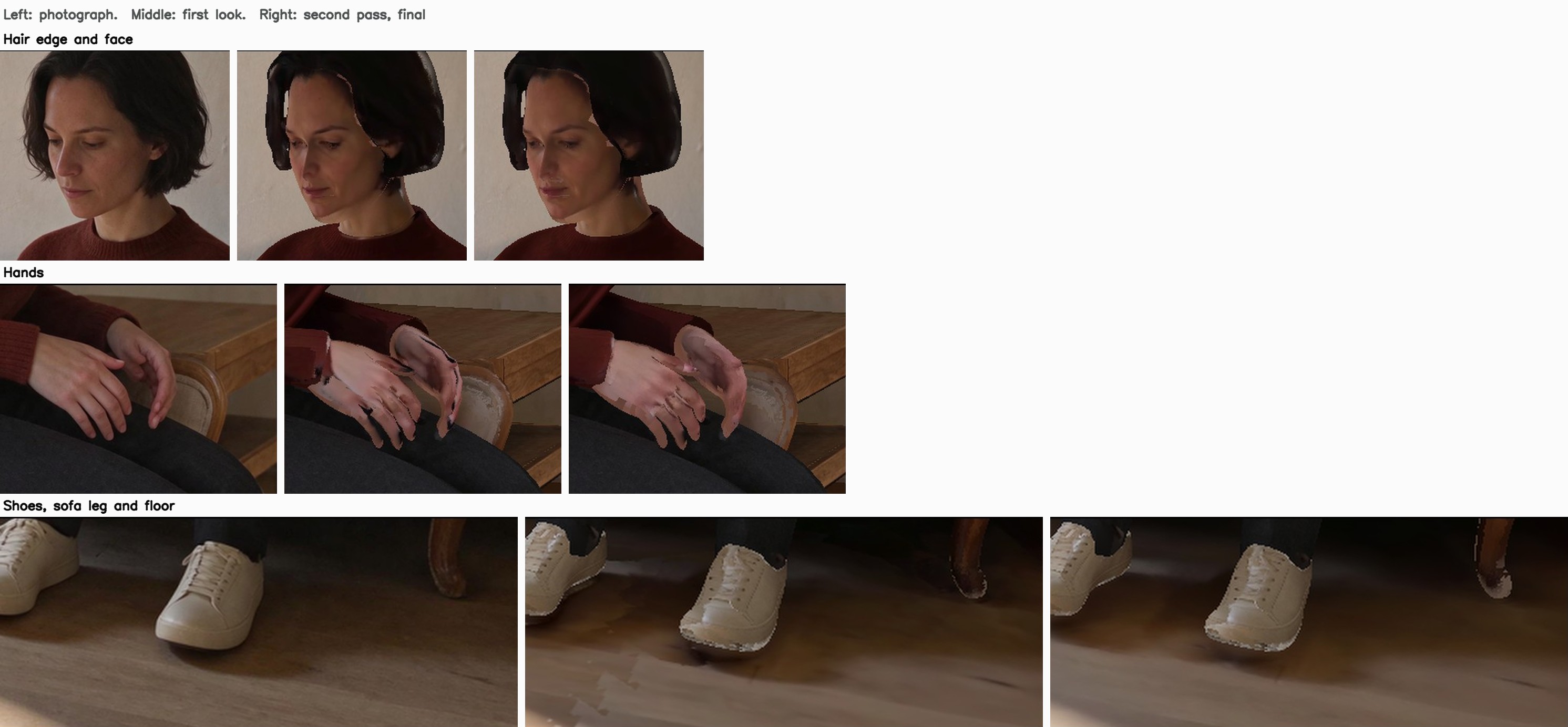
Three fix rounds followed an independent review at full size. They removed the leaks and left the hair, the hands and a wedge on the hip unchanged, because those are geometry. A carved hair shell is still a shell. Texture work does not repair the mesh under it.
Say what no camera saw
Six cameras on one side of a room do not see the room. Weighted by surface area, they observed 24% of the floor, 41% of the sofa and 28% of the back wall. Everything else is filled plainly from the same object and labelled inferred.
The toolkit renders a tour with every inferred pixel tinted. A full turn through this room was 57% measured and 43% inferred, and the wall behind the cameras was 0% measured. The tour shows that plainly, where a confident picture of a wall nobody photographed would not.
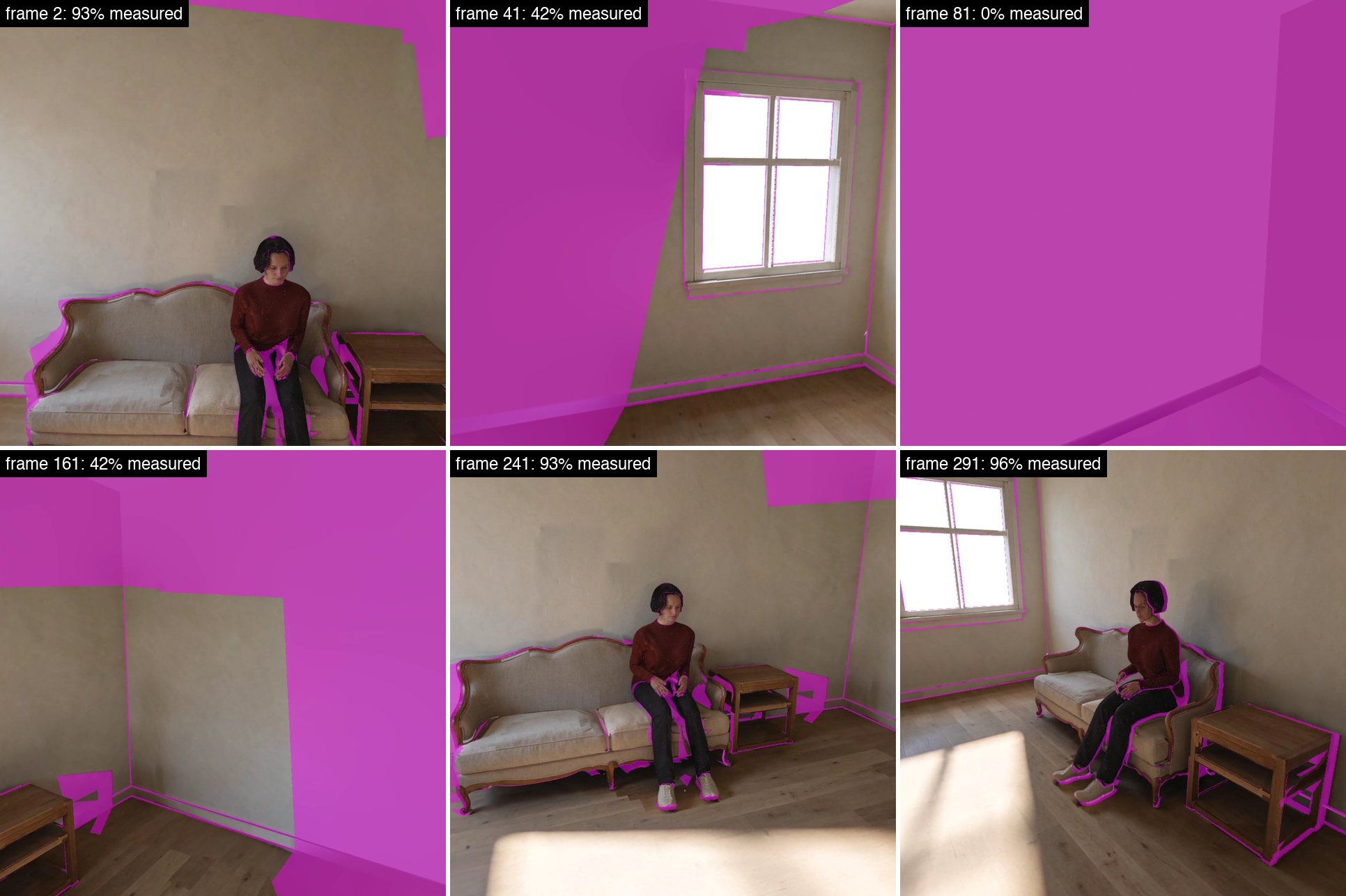
Leave-one-view-out adds a second kind of evidence: project five views, predict the sixth, and score only the pixels the others observed. After the fix rounds that held-out score was 28.3 dB, as a mean over five objects.
Relight what can be relit
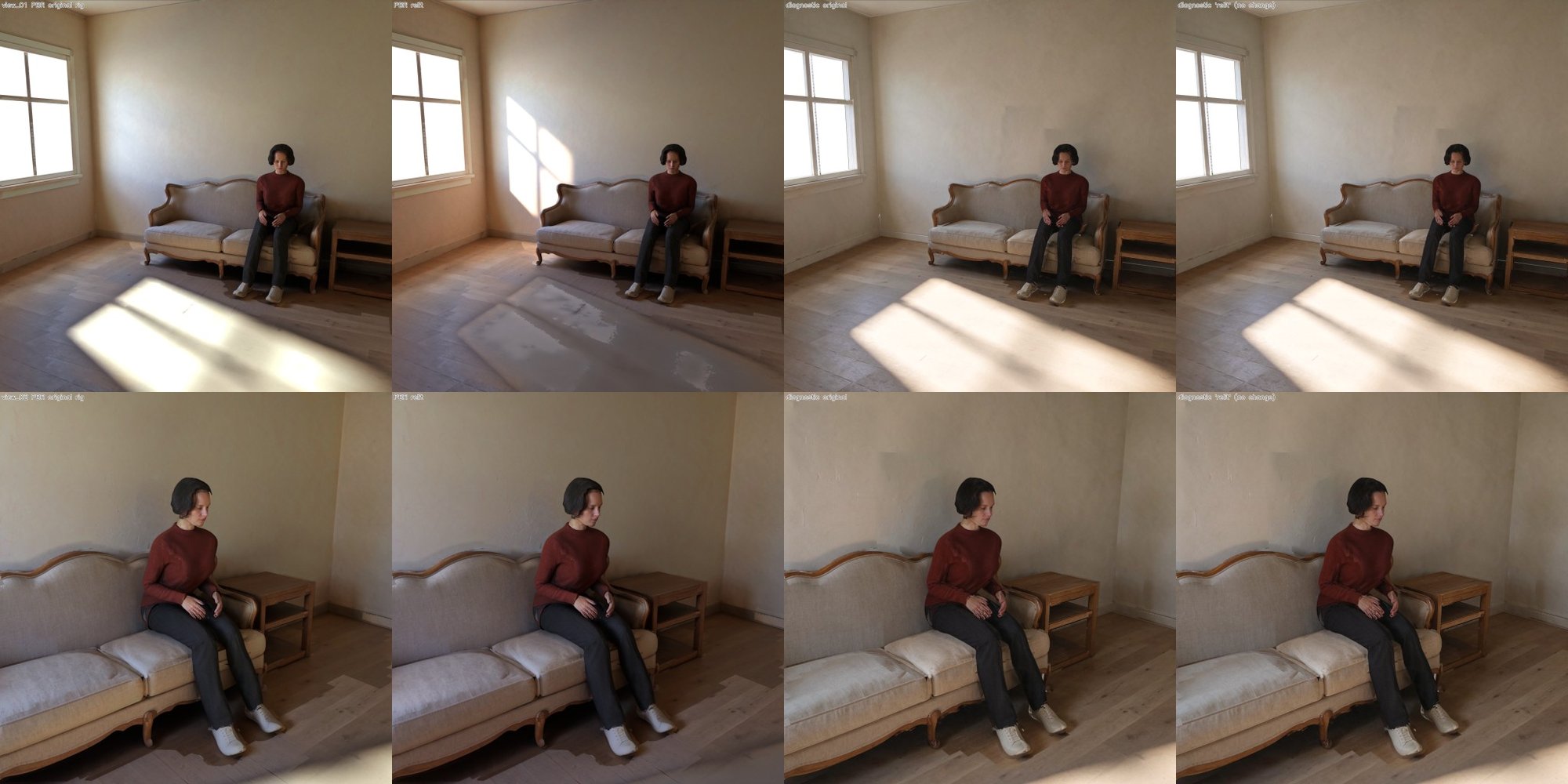
The second file is a PBR scene: base colour from the projected views with a conservative de-light, Principled materials, and the blockout's own sun and sky scaled against the targets. Its re-renders are 23.8 dB from the targets, where the diagnostic scores 26.2 dB; the diagnostic is the target colour by construction.
With the sun moved 70 degrees, the old sun patch on the floor collapses in one view (contrast 7.9 to 1.2) and only weakens in another (6.4 to 4.1). Large plain surfaces relight. A person keeps the shading it was photographed with.
Try one video instead of six pictures
The views disagree because each panel is painted on its own. I tried the obvious alternative: render the grey scene as a fly-through, have MiniMax H3 Max on fal re-render it, and project its frames.
The frames do agree. COLMAP registered all 109 of them as one scene at 1.09 px, and matches on the person survived its geometric check as often as matches on the room. The exploration also produced three wrong diagnoses in a day, each from trusting a single measurement: cameras 40 cm off, new cameras better, a shape off by centimetres. Each fell to a second, different check.
A second projection pass removed colour leaks at the fingertips and blocky patches on the floor. A collar line and a patch at the hair edge remain, and the hair is still a shell. This route is not a stage of the toolkit yet.
Keep the scene you blocked out
Install the skill for a supported coding agent:
npx skills add gokayfem/multiview-to-realThe repository documents the Python dependencies, Blender 4.2 or later and the fal key for the image model. Your own views can replace the generated ones, and a mock generator runs the whole chain offline.
A Gaussian splat or an image-to-3D model would hand back its own geometry. This keeps yours: the same meshes, their UVs, real lights. The price is that every disagreement between views has to be settled in the open, texel by texel.
What interests me is how much of this is measurement. The image model paints six pictures in one call. Deciding which pixel may land on which surface, and saying which surfaces nobody saw, is the rest of the work.